How to tell your employees you’re moving office

Moving right into bigger facilities is a huge action in the life of a business, standing for a brand-new possibility for development and adjustment.

This amazing time can come with its very own set of challenges, particularly for Chief Executive Officer’& rsquo; s and managers. Not just are they liable for a hill of lawful paperwork and relocating usefulness, yet they additionally need to break the information to other workers.

Whilst some workers will certainly be thrilled by the concept of a new office, others might see the action as an aggravation as well as interruption to their work life. For that reason, it is important for companies to reveal a relocate one of the most positive way feasible, recognizing any effects it may cause for staff members.

If this situation appears familiar, fear not. We’& rsquo; ve put together our top suggestions for employers when it concerns relocating workplace, including what to keep in mind when notifying staff members of possible modifications as well as just how to get them on board with your office step. Continue reading to discover extra:

Suggestion 1. Tell them immediately.

Whilst you won’& rsquo; t intend to elevate the idea pre-emptively, if you are far along in the relocating procedure your staff members must know your plans. This is specifically real for employee in greater settings, such a managers as well as group leaders, who may encounter questioning from various other staff member once the news is introduced. Making sure they get on board and comfy with your relocating plans will certainly help the procedure run as smoothly as feasible.

Be certain to connect all information clearly and properly, describing all the essential details with your personnel. This ought to be done both verbally (i.e. conferences) and also in composing (i.e. e-mails), permitting enough time for team ahead onward with any questions or inquiries. Considering making a timeline for your action as well as sharing it with your team, covering all essential dates as well as instructions, including packing guidelines, closure days and brand-new travelling alternatives. This will enable your workers to prepare for these changes in advance and sufficiently get ready for move day.

Pointer 2. Describe the reasons for the step. And also the benefits!

When it pertains to your office step, among the primary concerns you’& rsquo; ll be asked by employees is ‘& lsquo; why are we relocating?’

& rsquo; Whilst the answer might seem apparent to you, it may not appear that method to various other, causing confusion as well as possible animosity towards the choice. It’& rsquo; s vital to share your factors for moving with your employees. Whether it be to suit development plans, provide an asset to business or completion of a residential property lease, giving a reasonable factor will certainly assist ease complication and also permit staff members to understand the big picture when it concerns the modification.

In addition, you need to also ensure to point out the benefits of relocating workplace, both for business and for workers. This will certainly aid frame the change in a positive light as well as obtain people excited for relocating day. Possible worker benefits can be more parking, easier gain access to and improved connections, as well as larger workdesk space and improved services. Every one of which will certainly make the day-to-day life of your workers that a lot easier and also ideally improve company productivity.

Pointer 3. Involve them at the same time

A fail-safe way to obtain staff members thrilled regarding a relocation is to include them while doing so. One of the simplest, and also the majority of efficient methods to do so, is to ask what adjustments they’& rsquo;d like to see in the new space. This could consist of ideas for brand-new office layout, interaction channels or storage solutions, every one of which can help them do their work better.

Ensure you make it simple for employees to share these comments with you, in addition to illustrate just how they will certainly be implemented. In enhancement, enable personnel time to pack as well as organise their property prior to relocating day, to guarantee they are completely prepared and don’& rsquo; t feel they need to sacrifice their time to get points arranged.

When it comes to relocating workplace, it’& rsquo; s vital to celebrate the success that it stands for. Whether it’& rsquo; s a party at the end of moving day, a firm journey to the pub or also some freebies for employees, showing your thankfulness for their assistance at this time will go a lengthy means. See to it to deal with the step en masse success, fuelled by the hard work that every person has actually placed in both on moving day as well as before it.


< h2 design=” border: 0px; margin: 0px; cushioning: 0px; text-align: begin; -webkit-text-stroke-width: 0px;” >< period design=” font-family: Rokkitt,” Droid Sans”” >

Do you consider it a possibility to offer your service or product when you figure out that a firm is moving?< p style=” boundary:0 px; margin:0 px; cushioning:0 px; text-align: start;- webkit-text-stroke-width:0 px” >< period style =” font-family: Rokkitt,” Droid Sans “” >< period design =” border:0 px; font-size: x-large; margin:0 px; cushioning:0 px” > TMI’Business relocating leads supplies you with a listing of organisations that are relocating. You will certainly receive the list on a monthly basis and also well ahead of

the approaching relocations. With these prompt sales leads, you can comply with up and also offer your business & rsquo; s services and product to these companies that are relocating.< p design=” border:0 px; margin:0 px; cushioning:0 px; text-align: beginning


;- webkit-text-stroke-width:0 px” >

Visit TMI Leads for even more information.< p design= “boundary:0 px; margin:0 px; cushioning:0 px; text-align: start;- webkit-text-stroke-width:0 px” >< p style =” boundary:0 px; margin:0 px;

padding:0 px; text-align: beginning; – webkit-text-stroke-width:0 px “> Original Source: Just how to inform your staff members you’’re relocating workplace|Moving Matters< img alt=”” src= “https://storage.googleapis.com/lumotive-web-storage/noimagefound.png” style=” width: 225px; float: left; margin: 5px 10px;”/ > Office Relocations > How to tell your staff members you & rsquo; re relocating officeMoving into bigger premises is a substantial step in the life of a company, representing a brand-new chance for development as well as change.However, this ex-spouse …

Find out more


Office design critical to employee success, reveals Capital One’s Work Environment Survey

by Eileen McMorrow

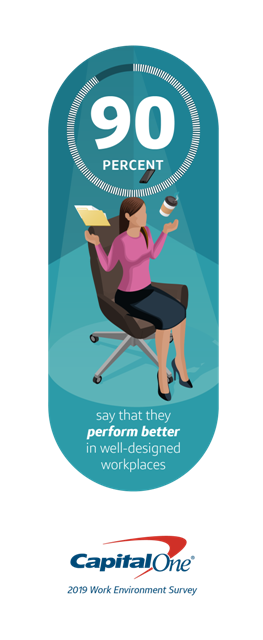
Excellent workplace style forms a base for success, according to the 2019 Capital One Workplace Environment Survey released July 30. This year’s data reveals that thoughtfully developed workplace are still top-of-mind for employees: Almost all staff members (90%) see that they perform much better in well-designed work environments. Further, staff members continue to state that great office design drives them to be more ingenious and productive. Millennials put an even more powerful emphasis on properly designed work environments with 35% agreeing strongly, compared to 32% of Boomers and 28% of Gen Xers.

The 2019 Capital One Workplace Environment Study asked 3,500 full-time office specialists, 18 and over, to share their ideas about the effect of work environment design and employee experience on their fulfillment, imagination and efficiency at work. The actions are consisted of 1,000 across the country + 2,500 combined designated markets (500 per market) for 3,500 total actions.

Flexibility and versatility are critical components of work environment design. Flexibility doesn’t simply use to design: staff members & rsquo; highest concern is finding business with flexible schedules and physical versatility in the office. Nevertheless, some shifts in year-over-year information suggest that employers need to remain adaptable and foster vibrant office design to accommodate workers’ changing choices. Sixty-five percent state they are more efficient when they alter their physical place while working while 73% have their finest concepts when they’& rsquo; re able to utilize flexible work space choices. Even more, 73% have the ability to work better when they have access to versatile furnishings plans such as different seated or standing alternatives.

Many telling, 88% say they carry out better when they have actually area for focused, heads-down work. And 45% state they wish to have space aside from their traditional workstation/desk for individual work.

For the second year in a row, a majority of staff members state that work environment style is as important, if not more vital than workplace area. Majority(54% )of employees state that office style is as important, if not more vital than workplace location. The number leaps to 64% amongst mid-level employees.

Almost one in five staff members (19%) state that workplace design is more crucial than workplace place. Millennials feel much more strongly, with 24% saying workplace style is more vital than workplace location.

“It used to be that Capital One was focused on its corporate real estate and center management functions, but 6 years ago, Capital One Realty chose to be a service to its staff members,”says Stefanie Spurlin, VP of Office Solutions, who went over the study findings in New york city in late July. “ We are relocating to workplace and individuals vs. real estate/FM plus buildings.”

Capital One conducts the survey so it can improve its own facilities. “We wish to keep employees and need to understand the function that office plays,” says Spurlin.  Space is not generational. There is a work type and character types or differences to be considered. Recruitment and retention are very important for older employees, Gen Z and Millennials.”

Workers (87%) anticipate business to support their psychological health and wellness. Millennials and Boomers feel a lot more highly, with 44% and 41% respectively stating this is very crucial, compared to just 36% of Gen Xers.

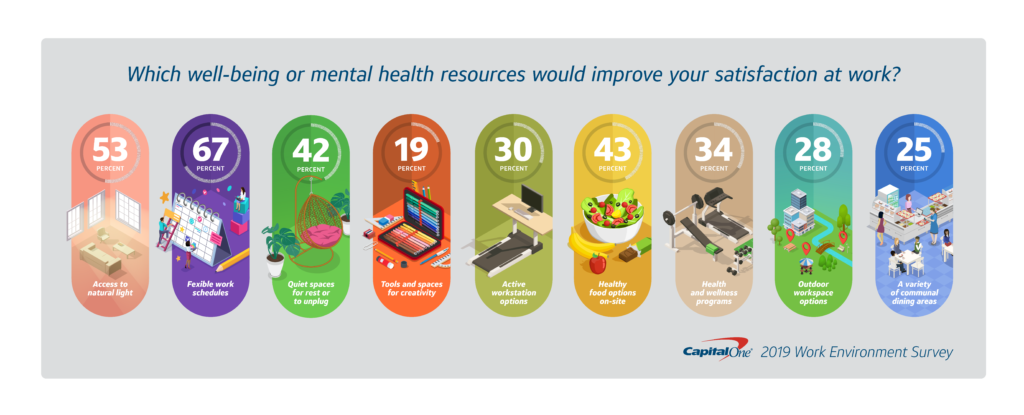
Flexibility isn’t only important in work environment style. More than 2 in 3 (67%) workers state a versatile schedule is a resource in this location that would enhance their fulfillment at work. Versatility is crucial: 81% of employees rank a versatile schedule in their leading 2 factors to stick with a business, up 8% from last.

Workplace design contributes in supporting mental health and well-being, too. 2nd to versatile schedules, over half of workers (53%) mention access to natural light as
a psychological health resource that would improve their fulfillment at work.
42% wants to have quiet areas in the workplace to disconnect.

Links to nature in the workplace can enhance well-being. More than one 3rd (36%) of staff members say they have no connection to nature in their office, despite suggesting that numerous kinds of connections (visual, physical or product) would enhance their performance and well-being. A visual connection to nature is looked for by 57%–– jumping to 62% amongst Boomers.

For Capital One, this is the second year gathering information at the nationwide and regional levels, with the very same sample sizes. Contrasts in between 2018 and 2019 information describe the 1,000 national participants, and market-specific comparisons are in between the very same market’& rsquo; s actions or the complete 2,500 sample. 2017 data is included with 2018 and 2019 data for referral of bigger trends just.

The post Workplace style crucial to worker success, exposes Capital One’s Workplace Survey appeared first on The McMorrow Reports.

10 Office design tips for happier employees

Are you looking for ways to make your employees happy? Check out these 10 office design tips to get your employees engaged and productive with their work!


Noise control: You might be thinking this pertains to construction work next door or the sound of traffic penetrating the walls, but the biggest culprit is actually the workers themselves, “and it often occurs in the open-plan office”. According to various global standards, office noise levels should be limited to about 35 decibels. The most disturbing noise? A phone left ringing.

Light: This isn’t just about staff satisfaction but also, surprisingly, levels of depression which have been found to lessen in light-filled rooms. Prior studies put forward three solutions. The first is to give employees a desk lamp of approximately 11 watts. The second is to have windows of at least 1.8 metres in height. And the third is to limit any glare to a glazed intensity of 40 per cent.

User control: Of course, giving employees control of their work environment, such as leeway to change the temperature of the air conditioning, has been found to ramp up happiness. Although, come to think of it, surely it would only be a matter of time before that happiness was replaced by conflict, right?

Privacy: “The privacy of office workers is better protected in an individual space than in an open-plan office,” write the scholars. But we live in a world of rising rents and corporate cost-cutting so the layout of the past is unlikely to return, hence the recommendation to place a cap on density so there’s some distance between employees. It’s also wise to provide them with larger, more-spacious desks.


Do you consider it an opportunity to sell your product or service when you find out that a company is relocating?
 

TMI Company moving leads provides you with a list of businesses that are relocating. You will receive the list on a monthly basis and well in advance of the impending relocations. With these timely sales leads, you can follow up and sell your company’s product and services to these businesses that are moving.


To learn more, visit https://tmileads.com for more details.


Source: 10 office design tips for happier employees

Noise control: You might be thinking this pertains to construction work next door or the sound of traffic penetrating the walls, but the biggest culprit is actually the workers themselves, “and it oft…

Read more


More people are working remotely, and it’s transforming office design

Working remotely is the new normal—and the increasing numbers of employees who work from home are, paradoxically, changing the nature of office design. As more and more companies recognize the value of allowing employees to work from home (the world becomes your talent pool, employees get better work-life balance, and it can even make workers more productive), more companies are operating offices that need to serve both in-person and remote workers.

The shift raises a question for companies: How do you design a space when a significant portion of your workforce uses it rarely or not at all? Fast Company spoke to three partly remote companies—project management software company Basecamp, enterprise software company Atlassian (which makes tools like Trello and Jira), and developer hosting service GitHub—to find out how they’ve designed their offices to accommodate everyone, regardless of where they’re working.

[Photo: Christopher Barrett/courtesy Basecamp]

Make working at the office more like working from home

When Basecamp got its start back in 1999, the company’s employees were all local. But when the fifth hire—David Heinemeier Hansson, who is now a partner at the company—was based in Copenhagen, Basecamp’s other founders also decided to try out remote work, too.

The remote-first nature of the company has deeply impacted Basecamp’s office design. CEO Jason Fried says he designed the office to “simulate what it would be like if nobody was actually at the office.” That meant making the experience of working in the office to be as close as possible to what it’s like to work from home.


[Photo: Christopher Barrett/courtesy Basecamp]

“If you’re at home in a second bedroom or no one’s around during the day, you’re not distracted,” Fried says. “You’re in an environment you can control for the most part and you work in isolation and get into deep work and [aren’t] bothered by other people. We wanted to create an office space to simulate the advantages of that, but also give an opportunity for people to get together in a sound-controlled environment.”


[Photo: Christopher Barrett/courtesy Basecamp]

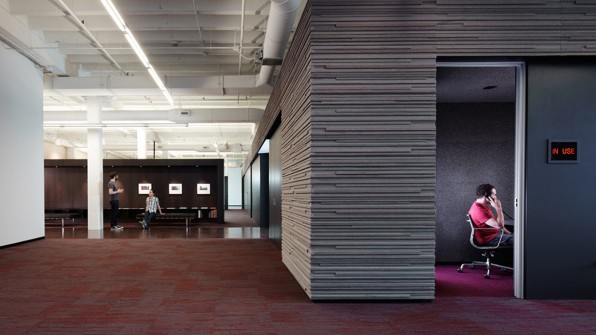
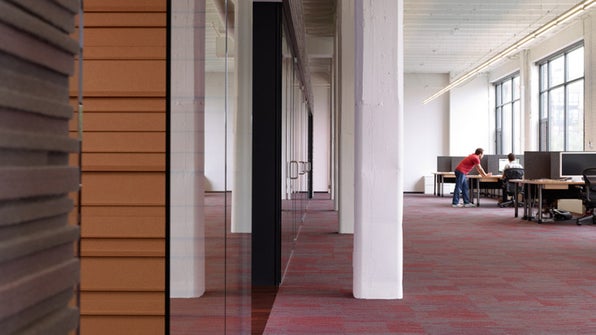
As a result, Basecamp’s office is more of a place to meet. There are acoustic materials on the walls to ensure that it’s always quiet. The desks are spaced at least 10 feet apart so you can’t see anyone when you’re sitting down and working. And for those inevitable conversations, Fried says, there are soundproof rooms.


At this point, Basecamp has become so remote-friendly that only a few employees still work out of the company’s Chicago office on a regular basis. As a result, Fried says the office is much too big for the company’s purposes. When the space’s lease comes up this year, he plans to move to a much smaller space—or maybe ditch the office altogether. Even so, Basecamp’s HQ provides one model for how to think about designing an office that is more of a meeting hub than a place to go sit at a desk.

[Photo: courtesy Atlassian]

Build more small, acoustically sound spaces

Not every company is nearly remote, like Basecamp. Others, like software company Atlassian, have smaller numbers of remote employees—the team that is responsible for the company’s popular Trello app is 70% remote—and operate a host of offices that many people travel to on a regular basis. That means that a lot of collaboration is happening in conference rooms, using video conferencing software.

[Photo: courtesy Atlassian]

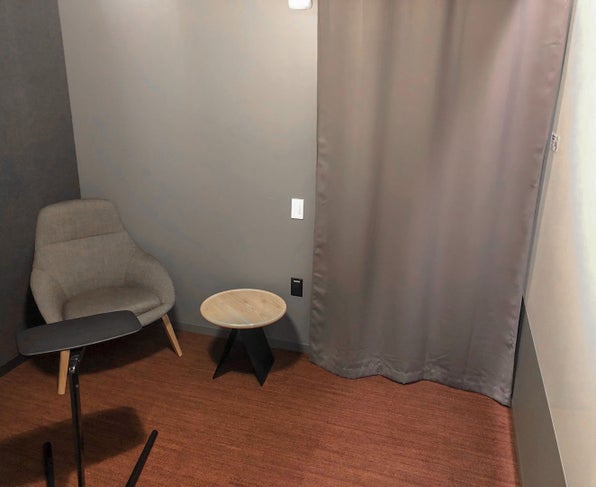
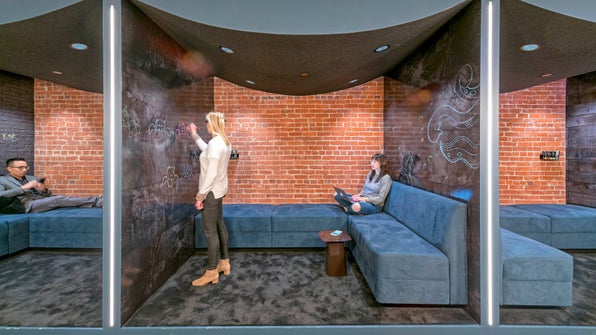
As a result, Scott Hazard, the global head of real estate and workplace experience at Atlassian, designed the company’s offices with lots of small, acoustically sound spaces. He heard from employees who were working out of one of Atlassian’s 12 offices that they needed smaller spaces more than they needed four- to six-person conference rooms, as many of them were collaborating with one other person who was working remotely. But to support these tiny soundproof conference rooms, Atlassian also provides other nooks around the office that act as overflow spaces. As Hazard put it, “Problems don’t get solved in a 30- or 60-minute window.” With these nooks, people can continue their video call outside a dedicated conference room without disturbing other people in the office.

These nooks also come in handy for larger meetings. Hazard says that when Atlassian acquired Trello in 2017, the team learned that you shouldn’t have seven employees sitting around a table for a meeting if even one person is dialing in remotely. Instead, Hazard says, “We encourage people to get on their own systems if someone is remote and create that democratic interaction model—everybody dialing into their own system and individually having a screen.” When everyone is individually dialing into conference video calls within the office, having places to sit that will muffle sound is a must.

[Photo: Jasper Sanidad/Rapt Studio/courtesy Github]

Showers, nap pods, and lunch are the best perks

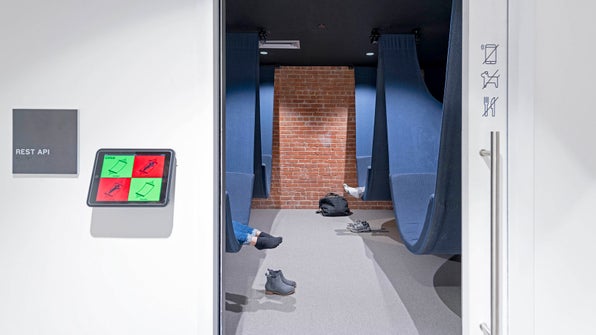
Employees who are traveling to come into the office may not have time to drop by their hotel after stepping off a red-eye flight. That’s why at GitHub, where more than two-thirds of the workforce is remote, the office features perks focused around helping employees get cleaned up after traveling. The company’s four offices have showers for exactly this purpose, and nap rooms for when jet lag hits.

“When you have employees who are local, who come into an office every day, their opinion of your office is the aggregate sum of many days—good, bad, and indifferent,” says Lara Owen, the director of workplace operations at GitHub. “With remote employees, we only have one or two days to get it right.”

[Photo: Jasper Sanidad/courtesy Github]

That’s why Owen and her team run focus groups and surveys with remote employees to ensure that the GitHub offices are meeting their needs.

“If you’re used to working in a home office all day and you come to a big, busy office, how do you adjust?” she says. The office has its own library, where remote workers who need absolute quiet can put their heads down. Atlassian also has libraries in its offices, and Basecamp practices what Fried calls “library rules” throughout the entire office to ensure that no one speaks too loudly and disturbs other people.

At GitHub, Owen’s focus groups also netted another change. “When I started [at the company], we had [catered] lunch two days a week,” she says. “We found out remote employees were booking travel based on opportunity to have lunch. We changed [the schedule] to lunch every day so remote employees can always have that social interaction.”

[Photo: courtesy Atlassian]

Give each team a home base so remote workers have a place to land when they visit

When remote workers do come into the office, they’re going to need a place to sit—and ideally, a place where they feel at home. “How do you travel to any one of our offices, and within an hour of grabbing your first cup of coffee feel part of the community with the teammates you may not see as often?” Hazard of Atlassian says.

To create that feeling, Hazard ensures that each office has central team spaces that are branded with the team’s name and function, where team members can also add their own decorations and personality. Then, when remote workers come into the office, there’s an immediate home base. He thinks of this space as the center of the team’s neighborhood or “village.” It also features lockers for people to use and no assigned seating. That way, all employees can “feel like everyone has a place and a purpose as well as create a local sense of community within a village [a group of desks].”


Do you consider it an opportunity to sell your product or service when you find out that a company is relocating?
 

TMI Company moving leads provides you with a list of businesses that are relocating. You will receive the list on a monthly basis and well in advance of the impending relocations. With these timely sales leads, you can follow up and sell your company’s product and services to these businesses that are moving.


To learn more, visit https://tmileads.com for more details.


Source: More people are working remotely, and it’s transforming office design

Working remotely is the new normal—and the increasing numbers of employees who work from home are, paradoxically, changing the nature of office design. As more and more companies recognize the value o…

Read more


An Overview on How to Make Your Next Office Move Super-Effective!


https://www.noobpreneur.com – 12 days ago on June 14th 2019

By Chad Stewart

An office move is bound to be a scarily difficult task, and one thing they’re not known for being is easy! So many things could go wrong… Picture this, one day after the move you’re looking for your favourite pen and you can’t find it. Documents flying everywhere, fights breaking out in the parking lot, it’s pure chaos! We don’t want this to happen.

In all seriousness, office moves are difficult to get right. They’re gritty and require someone who has great attention to detail. Hopefully our tips below can help you iron out any looming questions about your moving plan.

This is obvious, but it needs to be stated. The general rule of thumb is to start planning far in advance. Around 6-8 months in advance is perfect for a small to medium sized business. Time management is the key element for a successful move. Start by laying the groundwork of your logistical plan.

First things first, set a budget. Understand how much it will take for you to physically move all your equipment from location A to location B. It’s important for you to procure multiple quotes from various professional packers and movers, compare them to see who can provide you the best service for the best price. Moving companies are not in short supply now, you will be able to find multiple companies through a quick search on the internet or through your local yellow pages.

A common misconception is that once a plan has been made, it is an iron clad document that can’t be changed, this is a lie! Allow your plan room to breathe, in doing so, you’ll be letting yourself breathe.

You’re Not Alone

Teamwork makes the dreamwork! Projects that yield the best results are ones that a bunch of individuals equally collaborate on. So, don’t be afraid to delegate. Create a team of people who you can assign tasks to do and then set deadlines. It will limit stress and ensure that you keep to your time constraints, moving the process along nicely.

It’s important to know who needs to be involved and at what capacity. Upper management will need to be involved for the budget approval, but will they need to be involved for sealing boxes? Your IT Department will need to be involved in determining which equipment to move and how long it will take to reinstall it all in the new office, but they do not need to be involved in updating your address listings.

Psst, come in Alpha One, over. It’s important to be in constant communicationwith your team, the movers, the new buildings landlord, etc. If any person involved is kept in the dark, then this can lead to awkward settings. You do not want to arrive at the new office with a truck full of equipment to find out you don’t have the security clearance to come in and place your boxes. Similarly, let the concerned people know that you are moving out. Let suppliers/clients know where to redirect their monthly invoices, delivery of paper, or Christmas cards.

An office move is not just about sitting around a table and discussing which tape to use when sealing boxes, no, it is a project rife with opportunity. For example, your IT Department will have been bugging you about getting a new printer for years, but there was never a perfect time to grant their wishes. You can use your packing time to undertake a definitive hardware audit. Understand what physical equipment you have, what is needed and what is obsolete, and update accordingly.

Pro Tip: The equipment you have deemed obsolete and will not be moving to the new location can be recycled, yes, but you can also save money. Movers will typically calculate their cost based on items and weight they’ll be moving. So, if you can cut down on the number of items you’re moving, and hence decreasing the weight of the overall move, you’re in the green!

After Care

While preparing and conducting the move, it would be great to get your team to document a list of all the tasks they have completed. Now you’re standing in your new space, you can refer to that checklist, and make sure everything is perfect. For example, one of your team members documented that 10 chairs belong to the Accounting Department – does accounting have 10 chairs now? Another team member documented every client/supplier they corresponded with regarding your new address – give them a friendly call back to remind them, all in the name of double checking.

In this day and age, IT services are vital to the everyday health of your business. Take care in the early days that all your systems are up and running smoothly. No internet connectivity issues, no phone line issues, servers and databases are working fine.

Conclusion:

Office moves are difficult. The whereabouts of your favourite pen is imperative to your work life. Therefore, it’s important to take a second and really plan everything, so your move becomes easier and that you can always keep an eye on your pen. You’re not alone in this daunting task, create a team to help you and delegate wisely! Make sure to keep a healthy line of communication between all parties involved in the move. Be proactive and grasp the opportunities in front of you, whether that be an impromptu hardware audit or getting the most out of your team. Keep everyone honest by being due diligent after the move, you’ve come this far, so stick the landing.


Do you consider it an opportunity to sell your product or service when you find out that a company is relocating?
 

TMI Company moving leads provides you with a list of businesses that are relocating. You will receive the list on a monthly basis and well in advance of the impending relocations. With these timely sales leads, you can follow up and sell your company’s product and services to these businesses that are moving.


Visit https://tmileads.com for more information.


Main Image Credit: Neil Kandalgaonkar/Flickr

Source: 

An office move is bound to be a scarily difficult task, and one thing they’re not known for being is easy! So many things could go wrong… Picture this, one day after the move you’re looking for your f…

Read more


What’s Trending in Creative Office Design

This post originates from http://www.hwholmesinc.com – a month ago on May 15th 2019

By Brian

Office design today plays an integral role in a company’s branding, success, and growth. Modern offices have evolved from the days of soul-sucking high cubicle walls and horrible fluorescent lighting. The workplace today is all about experimentation and breaking from tradition. Today’s employee can be as nomadic as they choose to be – thanks to technology and connectivity. This is the ideology behind the rise of today’s creative office. In this blog post, H.W. Holmes, Inc – Southern CA office tenant improvement specialists – spotlight a few trends we’ve noticed in the creative office space niche.

Free-Range Cohabitation Spaces

Co-working spaces have been booming for a few years. Especially in the Southern California region where the tech sector reigns supreme. The traditional co-working space evolved from the tech incubator concept. Multiple tech startups choosing to work under one roof rather than leasing individual spaces.

However, the walls are coming down now. Whereas co-working spaces used to be individually compartmentalized, they are now free-range. No dividers from one company to the next. The idea behind this is to maximize collaboration and creativity. Companies in these open-floor offices today aren’t just sharing the same space. They’re also sharing the same resources. Often even the same talent.

Businesses beyond the tech sector are also getting in on cohabitation spaces. Some of the world’s biggest corporations are flocking to co-working spaces to find young talent, potential acquisitions, and for the flexible office setup.

Characteristics of this type of a free-range co-work space include:

  • Open floorplan
  • A lot of glass
  • Greenery and plants
  • Collaborative areas
  • Multi-use meeting areas
  • Community desks
  • No cubicles
  • Portable green wall partitions/dividers
  • Comfy couches and seating
  • Lightweight and mobile furniture
  • Unconventional creative spaces
  • Coffee and espresso bars

Second Nature – Biophilic Design & Plants

Being stuck indoors is one of the more disheartening aspects of working at an office. Between working longer hours and longer commute times, many office workers miss nature. This is why many companies are bringing nature to their office design.

Biophilia – the incorporation of green walls, plants, natural materials and textures (wood, stone, and clay), natural lighting, and waterfalls into an office design – has blurred the boundaries between the indoors and outdoors.

Biophilic design, along with other sustainable design practices like LEED and the WELL Building Standard, is part of a green revolution in office construction. It’s been shown that workers are happier and perform better exposed to natural stimuli. Biophilic design coupled with on-site wellness programs is playing a critical role in reducing workplace stress and improving morale and productivity.

Abstract & Geometric Patterning

It should come as no surprise that the creative office isn’t conservative. Gone are the days of characterless single-solid color walls. Especially drab white walls and rows of cubicles.

Today’s office features bright and vibrant colors. Plus geometric patterns and abstract designs. It has personality. Warm colors work in conjunction with pastel or bold and evocative patterns. This better conveys a company’s culture and personality. This accentuation is aesthetically-pleasing. Employees love it. As do potential prospects and clients.

Abstract geometric shapes and accent designs are particularly great when it comes to transforming creative spaces, reception areas, and employee break rooms or kitchens.

  • Warm and bold colors
  • Contrasting colors, particularly black and white
  • Evocative design statements
  • Unique Patterns and textures
  • Adaptive Re-Use Makes Old New Again

Old buildings are finding new life repurposed as creative office spaces. Adaptive re-use is bringing a second lease of life to dilapidated brick structures, long-abandoned shopping malls, or deserted manufacturing plants and warehouses.

The ageless features of fantastic old buildings. The rough but sturdy and historic structures. These are great spaces for a new vibrant creative office.

Some reasons we’ll be seeing more adaptive re-use and repurposing in the years to come:

  • Historic preservation
  • Energy-efficient sustainable construction
  • Money and time saved using an existing structure
  • Added character and charm

    Assistant


    Do you consider it an opportunity to sell your product or service when you find out that a company is relocating?
     

    TMI Company moving leads provides you with a list of businesses that are relocating. You will receive the list on a monthly basis and well in advance of the impending relocations. With these timely sales leads, you can follow up and sell your company’s product and services to these businesses that are moving.


    Contact https://tmileads.com for more information.


    The post What’s Trending in Creative Office Design appeared first on H.W. Holmes Inc..


5 Smarter Alternatives to Open Plan Offices

Do you consider it an opportunity to sell your product or service when you find out that a company is relocating?
 

TMI Company moving leads provides you with a list of businesses that are relocating. You will receive the list on a monthly basis and well in advance of the impending relocations. With these timely sales leads, you can follow up and sell your company’s product and services to these businesses that are moving.


Visit TMI Leads to find out how!

Check out this original article about open plan offices!


5 Smarter Alternatives to Open Plan Offices | Inc.com

The Philadelphia Inquirer recently cited me and my views of open plan offices in an article titled “Everybody loves to hate the open office, but is it dead yet?” While the article is balanced, author …

Read more


Make Ethernet Based Connectivity a Leading Item on Your Office Moving Checklist

One of the most overlooked items on small businesses’ office moving checklists is connectivity or Internet access. While almost all office spaces are expected to come with some level of connectivity, some Internet services may not meet the requirements of some business applications. Knowledge of the details of available services and providers is a must before businesses move into new office spaces.

For most businesses, an office moving checklist prioritizes things like location, furniture, pricing, security and other logistical considerations. Very little consideration is given to how the business will be connected online. Even when the business owner is cognizant of the need for reliable connectivity, they often don’t find out enough information about the type of connectivity available.

Mass market broadband access is not adequate for many businesses

Most small business owners usually focus on Internet speed as the single measure for the performance of an Internet connection. While most offices come with Internet access with impressive nominal download/upload speeds, most of these services are mass market or “best effort” broadband services.

Mass market broadband services, including some advertised as business cable or business DSL, will work perfectly well for applications such as email and web browsing. However, for other more demanding business applications such as video-conferencing, high speed cloud access, Voice over Internet Protocol (VoIP), high frequency trading, and many other emerging applications, mass market broadband won’t cut it.

Because mass market broadband is designed primarily for home users, it is shared. The providers reckon that users in each community cannot be online at the same time, so they over-subscribe the bandwidth sold. A 50 Mbps connection may fall to less than 15 Mbps depending on the number of people online at the same time. Moreover, mass market broadband Internet access does not come with quality of service (QoS) guarantees. As a result they may have high packet loss, latency and jitter that make them unsuitable for some mission critical applications.

Many small businesses find themselves having to ditch their “high speed” mass market broadband services for T1 lines. T1 lines come with guaranteed bandwidth and quality of service. Unfortunately, T1 line speed is typically 1.5 Mbps (3 Mbps with bonding), far below today’s bandwidth requirements.

Include fiber lit buildings or buildings with Ethernet over copper on your office moving checklist

There is a finite probability that there are office buildings near you that are already connected to a fiber optic network of one or more providers. Most fiber lit buildings have Ethernet over fiber services readily available. However, only about 1 in 4 buildings are connected to fiber and you may be unable to find one that also matches other important items on your office moving checklist. There are much better odds that you will find office buildings connected by Ethernet over copper.

For serious business applications, Ethernet Internet access is the in-thing and should be one of the leading items on your office moving checklist. Ethernet does not only provide high speed access to the Internet – up to 50 Mbps with copper and a whopping 10 Gbps with fiber – but it can come with guaranteed bandwidth and QoS.

In addition to the extremely low cost per Mbps, you will be able to run multiple services over Ethernet. For example, in addition to Internet access, you can implement SIP trucking for your voice communications and avoid paying for separate voice lines.

One of the many other attractive features of Ethernet is its flexibility. As you move into the new office, you could subscribe for as little as 10 Mbps if your requirements and budget so dictate. But as your business grows, you will be able to quickly increase bandwidth by small increments.

We are now in the 21st century where every business, whatever the size or  industry, needs reliable connectivity to be successful. With carrier Ethernet services now widely available, businesses should take full advantage of them where available. Ethernet access service should be a leading item on any businesses’ office moving checklist.

The post Make Ethernet Based Connectivity a Leading Item on Your Office Moving Checklist appeared first on Fiberguide.

Source: Read more


3 Crucial Things That Can Make or Break Your Office Move

Are you considering an office move in 2019? Here are our three favourite tips to keep your relocation on track.

Forward Planning

The average office move can take months to complete. You might know where you are going, but do you and your team understand how you are going to get there? From packing crucial documents to informing suppliers and clients, each task should be considered and planned for. Start from moving day and work backwards, make a note of everything that needs to be completed and when in the schedule it must happen.

A disorganised move is not only stressful for everyone involved; it can also result in additional costs. Will you stay with current service providers or switch contracts? If so, how much notice is required to prevent unnecessary penalties? Clarity on the details from the beginning will save you a lot of money in the long run.

Open Communication Channels

An office move can be difficult for some staff members. They might need to alter their commuting patterns or even relocate to another area. Be aware that this can lead to an upheaval in their home life, alongside the changes that are happening at work. Include them in discussions on important factors such as the expected timeframe of the move and the effects this might have on staff leave or normal working hours. You could even ask for feedback on other decisions such as the office layout and catering facilities at the new site.

Be Clear on Costs

There are many unexpected costs that can arise during an office move. It is important that you consider every aspect of where your limit stands and how you will adapt should an unplanned expenditure come into the equation. Do your research on the different options and how they fit into your budget. From removal firms to additional furniture for a bigger office; do you know how these additional expenses will fit around your existing daily running costs? It is also worth considering whether the move itself will have a direct impact on your turnover.

Be prepared and you will start your new era of business with a positive, rather than negative, impact on your business bank account.

Source: NGT Products

Considering an office move in 2017? Here are our three favourite tips to keep your office relocation on track.

Read more


5 Types Of Furniture For Green Office Buildings

Going green is the right thing to do for business. It is also the smart thing to do. The more eco-friendly your company is, the more consumers will want to do business with you. Environmentally responsible businesses can minimize their carbon footprint while increasing their profits. But, going green for business is about more than just creating an environmentally responsible office building. What you put inside the building is just as important. There are many different types of green office furniture. If you are an environmentally responsible business owner, you need to furnish your office with environmentally sustainable furniture. Find out the 5 types of furniture for green office buildings below.

Pre-Owned Office Furnishings

Buying antique office furniture is one of the most environmentally friendly ways to furnish your office. It is also the most fiscally responsible. Pre-owned office furniture is much cheaper than new desks and chairs. In fact, you can often find old office furniture available for free with pickup when you do a bit of searching online. As long as your used office furniture is still in good condition, no one will be any wiser about its origin. And, you can still tout your green business office in client communications without having paid a cent for fancy eco-friendly furniture. These are just a few of the many reasons why used office chairs and desks are some of the top green office furniture to look into purchasing.

Reclaimed Materials

Office furniture made with reclaimed materials is another one of the top types of furniture for green office buildings. Office shelving and desks made of reclaimed wood make for a beautiful office environment. They also tend to last longer. These types of green office furniture use sturdier materials that stand up to wear and tear better over the years. Reclaimed glass office decor, reclaimed wood furnishings and reclaimed steel office storage products are just a few of the reclaimed office furniture options that you can look into. Keep this in mind to design a green office for your business.

Bamboo Furniture

Bamboo office furniture is another environmentally friendly option for a green building. Bamboo is a sustainable and light weight construction material used to make furniture both for the office. While it is much more environmentally friendly than traditional office furnishings, it is still just as beautiful and high-quality as some of the best office copiers. In fact, buying bamboo office furniture can elevate your office design overall with its sleek, smooth finish. This is just one of many materials that can help your business go green, but it is certainly among the list of the 5 best types of furniture for eco-friendly offices.

Cork Furnishings

Office furniture made from cork is another variety of environmentally-sustainable office furniture. Cork furniture is one of the newest types of products to hit the market. It is also one of the most environmentally friendly for green office buildings. Cork desks, cork shelving and cork storage are just a few of the cork office products you can use to furnish an environmentally-responsible office. Some of the products re-purpose old wine corks to make furniture. Others make use of new cork to create new cork office furniture, as it is a highly sustainable material. These types of furniture will make your green building look bold, modern and sleek.

Certified Office Furniture

Office furniture that has been certified as environmentally friendly is the best type of green building furnishings to buy. In order to receive Cradle to Cradle certification, ANSI/BIFMA level certification and SCS Indoor Air Advantage certification, office furniture must meet stringent guidelines to prove its environmental sustainability. When you shop office furniture with eco-friendly certifications, you help the environment as well as your business’s bottom line. It can qualify you for LEED credits, which will lessen your business tax burden at the end of the year. The tax savings businesses benefit from with ANSI/BIFMA level, SCS Indoor Air Advantage or Cradle to Cradle certified office furniture make these options some of the best eco-friendly office furniture pieces for green buildings.

Furnishing a green office building requires a bit more research, planning and shopping than most businesses owners are used to. You may have to choose between eco-friendly worktops and regular table tops. However, it is certainly a worthwhile endeavor to limit your business’s ecological footprint and promote social responsibility at your organization. Consider these types of furniture for green office buildings above. These green office furniture options are some of the most stylish, sustainable furnishings you can find. They can also benefit your business’s finances while furnishing your green office building space.


Original Source: Style Motivation

5 Types Of Furniture For Green Office Buildings Going green is the right thing to do for business. It is also the smart thing to do. The more eco-friendly your company is, the more consumers will wan…

Read more